What is Hinamatsuri? (March 3 – The Peach Festival
Hinamatsuri, or Girls’ Day, is a traditional Japanese celebration held every year on March 3rd.
It is one of Japan’s five seasonal festivals and is also known as the “Peach Festival,” a day long cherished as a time to pray for the healthy and happy growth of girls.
Peach blossoms have long been considered symbols of protection, longevity, and even the power to bring people together.
For this reason, the Peach Festival is especially associated with good relationships and harmonious connections.
Peach blossoms also signal the arrival of spring, giving Hinamatsuri the meaning of welcoming a new season.
Hinamatsuri is not only a celebration for children.
Seasonal festivals were originally held to protect people from illness and misfortune, so many families also take this day to wish for their own health and well‑being.
Why Do We Display Hina Dolls?
When we think of Hinamatsuri, the first image that comes to mind is the Hina dolls.
The origin of Hina dolls is said to come from “nagashi-bina”, a Heian-period custom in which paper dolls were used to transfer one’s misfortune and then floated down a river to protect people from harm.
Today, Hina dolls are considered symbols that protect children from misfortune and wish for their healthy, happy growth.
In the past, people believed that dolls could take on one’s misfortune in their place, and this idea is thought to be the foundation of the modern Hina doll tradition.
The gentle expressions of the Emperor (Odairi-sama) and Empress (Ohina-sama) reflect the hopes and prayers of the family.
It is also said that the best time to start displaying Hina dolls is around Usui, one of the 24 solar terms.
As snow begins to turn into rain and the first signs of spring appear, this period has long been considered an auspicious time to welcome the new season.
Large sets are often displayed in the living room or a Japanese-style room, while smaller sets may be placed on a shelf or near the entrance.
There is no strict rule about when to put the dolls away, but many families pack them up on a clear day after Hinamatsuri.
There is also a traditional saying that putting the dolls away promptly brings good fortune in future relationships, though it is seen more as a cultural custom than a strict belief.
The Meaning Behind Hina Doll Decorations (Tiered Display)
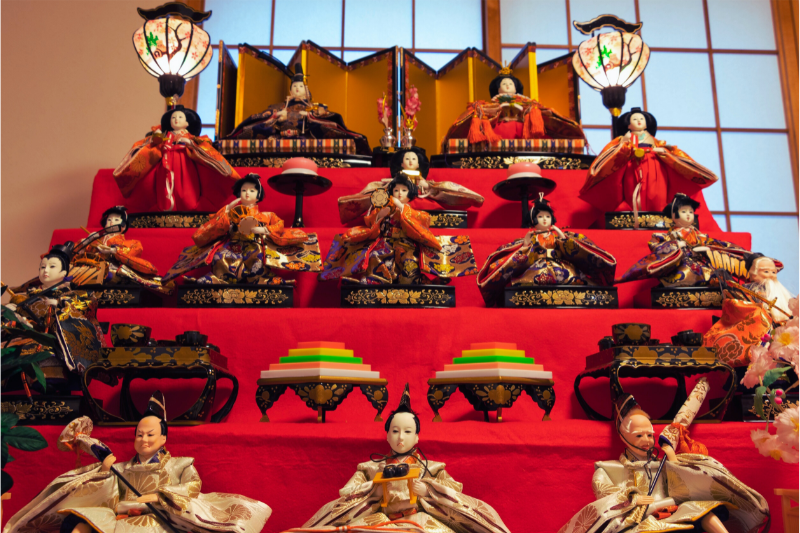
When displaying Hina dolls, families arrange not only the Emperor and Empress but also various attendants and decorative items.
The number of tiers and accessories can vary depending on the maker and the quality of the set.
Here, I would like to introduce the traditional arrangement of a full Hina doll display.
First Tier: The Emperor and Empress
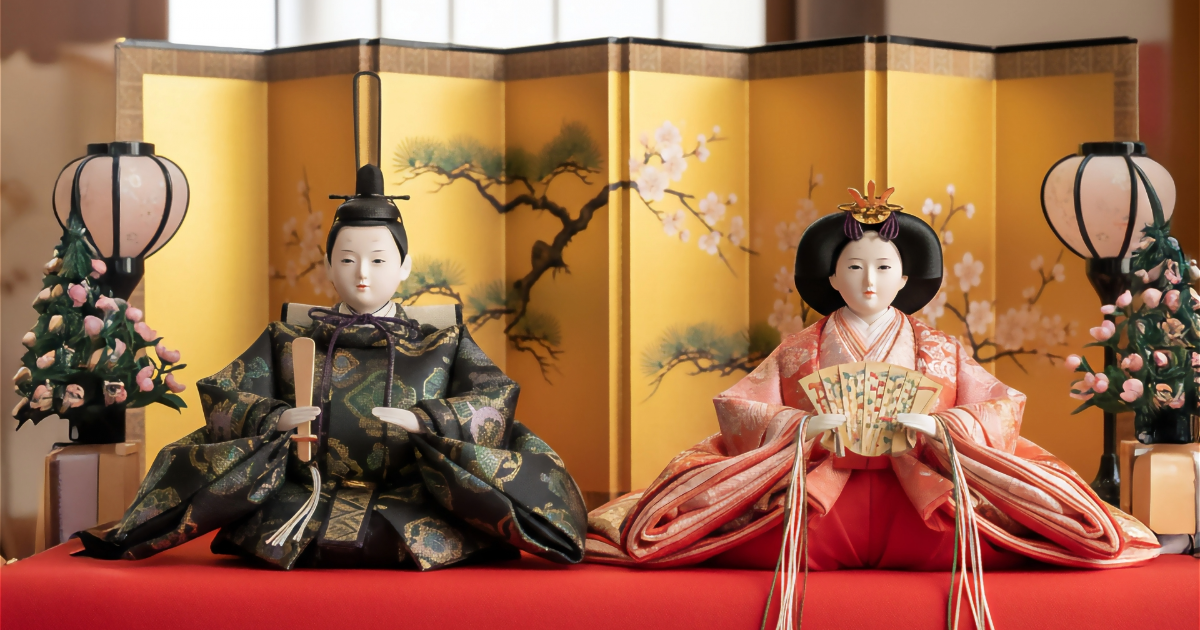
The Emperor (Odairi-sama) and Empress (Ohina-sama) are the main figures of the Hinamatsuri display, symbolizing a happy and harmonious marriage.
The Emperor holds a ritual baton called a shaku, carries a sword at his left side, and wears a traditional court crown.
The Empress holds a hiōgi, a fan made of cypress wood, and wears a golden hair ornament called hirabitai.
Around the couple, peach blossoms and lanterns (bonbori) are arranged, while the golden folding screen and their elegant costumes create a festive spring atmosphere.
Their calm and gentle expressions reflect the family’s wish for a peaceful and happy life.
Second Tier: The Three Court Ladies
The Sannin Kanjo are three court ladies who serve and assist the Empress.
From the left, they hold traditional items called Kuwae-no-chōshi, Sanpō (or Shimadai), and Nagae-no-chōshi.
Each lady carries a different ceremonial tool, and there is a common belief that the lady in the center represents a married woman.
Their graceful appearance reflects the elegant atmosphere of the imperial court.
In recent years, many families choose to display only the Emperor and Empress (shinnou kazari), while others include the Three Court Ladies as part of a three-tier set.
Third Tier: The Five Musicians
The Gonin Bayashi are five young musicians who perform instruments such as drums and flutes, adding a festive atmosphere to the Hinamatsuri celebration.
Their charming poses with musical instruments make this tier one of the most beloved parts of the display.
From the left, they hold the following instruments: Taiko (drum), Ōtsuzumi (large hand drum), Kotsuzumi (small hand drum), Fue (flute), and the last performer is the singer (Utai).
Fourth Tier: The Ministers (Zuijin)
The Zuijin are two court ministers who serve as guards protecting the Emperor.
They are known as the Left Minister and Right Minister, with the Left Minister depicted as an older man and the Right Minister as a younger one — a contrast that adds a sense of formality and tradition to the display.
They hold a bow in the right hand and arrows in the left.
These are not weapons for battle, but ceremonial items used in court rituals.
In the center of this tier, a set of hishidai (diamond-shaped stands) with hishimochi (layered rice cakes) is displayed, and on both sides, small ceremonial trays called gozen are arranged.
Fifth Tier: The Three Attendants (Shichō / Jichō)
The Shichō are three attendants responsible for various tasks.
They are known for their expressive faces — crying, smiling, and angry — which is why they are sometimes called Sannin Jōgo (“the three expressive ones”).
Their human-like expressions make them one of the most charming and relatable groups in the entire display.
From the right, they hold: Tategasa (standing umbrella), Kutsudai (shoe stand), and Daigasa (a round-topped ceremonial umbrella).
On the far right of the tier, a Sakon no Sakura (cherry blossom tree) is displayed, and on the far left, a Ukon no Tachibana (tachibana orange tree).
Sixth Tier: Bridal Dowry Items
The sixth tier displays traditional bridal dowry items — belongings that a bride would bring from her family home when she married.
These miniature pieces are beautifully crafted and offer a glimpse into daily life in the past.
The set typically includes: a chest of drawers (tansu), a long storage trunk (nagatoshi), a sewing box (hasamibako), a dressing table (kyōdai), a needlework box (haribako), a brazier (hibachi), a clothing bag (ishōbukuro), and tea ceremony utensils.
Seventh Tier: Imperial Carriage and Palanquin
The seventh tier features traditional modes of transportation, symbolizing the elegance of a royal procession.
The Gosho-guruma is an ox-drawn carriage used outdoors, while the Okago is a palanquin used indoors.
Some displays also include jubako, tiered lacquered boxes used for serving celebratory New Year’s dishes.
Hinamatsuri Foods
Chirashi Sushi
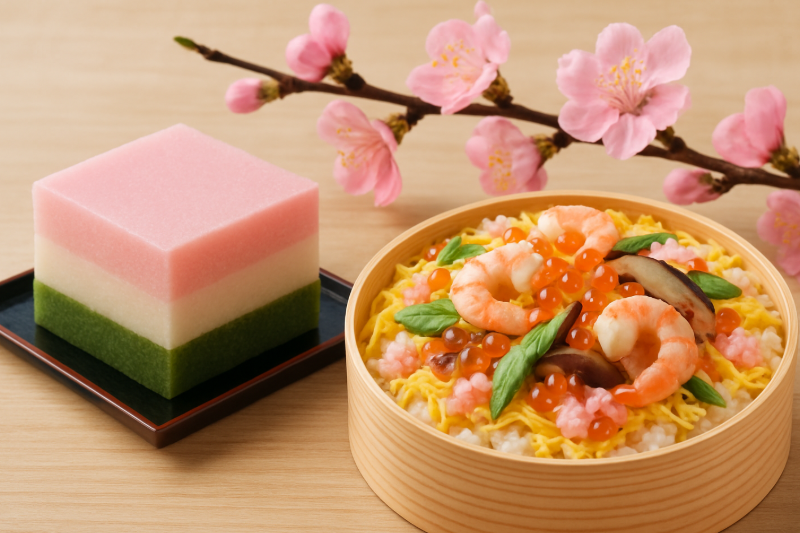
Chirashi sushi is the most iconic dish enjoyed during Hinamatsuri.
It is beautifully decorated with colorful toppings, giving it a bright and spring-like appearance.
Each ingredient carries a special meaning:
- Shrimp – A wish for long life, symbolized by the curved shape of the shrimp, like the back of an elderly person.
- Lotus root – Because it has holes, it represents “a clear view of the future.”
- Beans – A wish for good health and the ability to work diligently.
- Shredded egg (kinshi tamago) – A symbol of wealth and prosperity.
- Sakura denbu – Adds a soft pink color that represents spring.
- Salmon roe (ikura) – A symbol of prosperity and the wish for future generations to flourish.
I once tried making chirashi sushi by hand, and it was quite a challenge!
These days, many supermarkets sell ready-made chirashi sushi during Hinamatsuri, so it’s easy to enjoy without the extra effort.
Hishimochi
Hishimochi is a diamond-shaped rice cake made of three colors, each with its own meaning.
- Pink – Protection from evil spirits
- White – Purity
- Green – Health and the vitality of nature
When these three layers are stacked together, they express wishes for the arrival of spring and the healthy growth of girls.
Clear Clam Soup (Hamamguri no Osuimono)
Hamaguri clams have long been considered a symbol of good relationships and marriage.
Because each pair of clam shells fits perfectly only with its original partner, they represent the wish to “meet a lifelong, faithful partner.”
This gentle, delicate soup is a perfect dish for Hinamatsuri.
Hina Arare
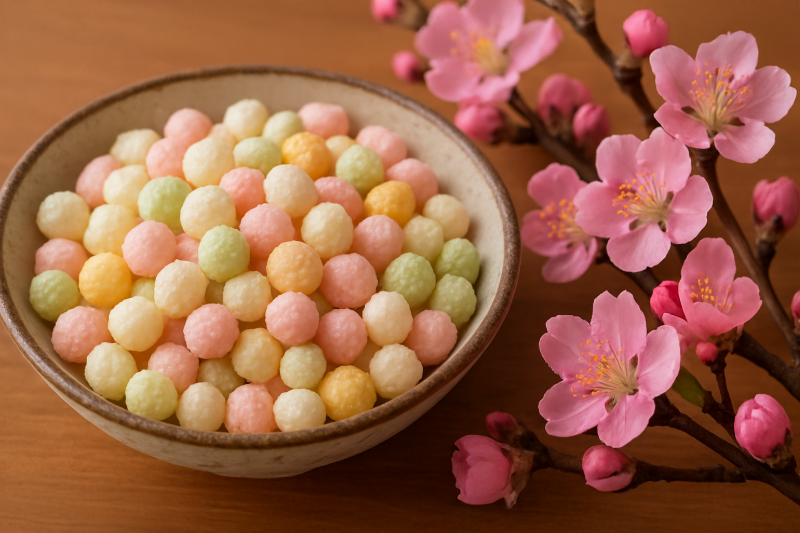
Hina arare are small, colorful rice crackers enjoyed during Hinamatsuri.
There are regional differences:
- Kanto (Eastern Japan): Sweet, puffed-rice style
- Kansai (Western Japan): Savory, crunchy okaki style
The four colors — white, green, yellow, and pink — are said to represent the four seasons.
They carry the wish for children to “stay healthy throughout the entire year.”
Shirozake (Sweet Rice Wine)
Shirozake is a traditional drink for adults during Hinamatsuri.
It has a gentle sweetness and a pleasant aroma.
For children, a non-alcoholic version called amazake is often served instead.
How Hinamatsuri Is Celebrated Today
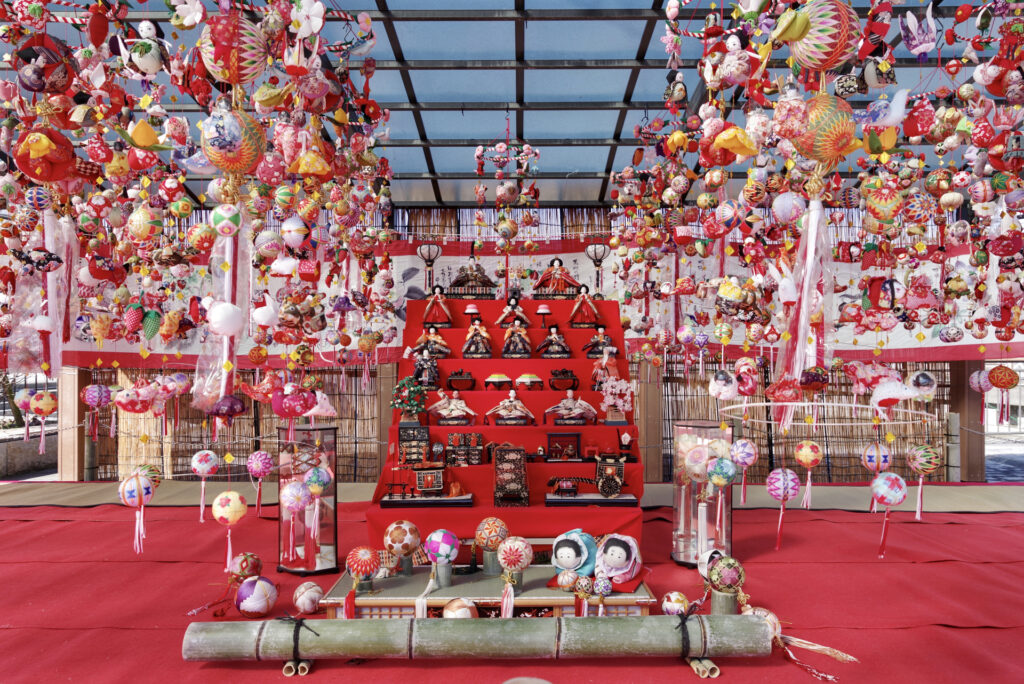
In modern times, fewer families display the traditional seven-tier doll set.
Compact Hina dolls in glass cases have become the most common style.
Even in busy households, placing a small set in the entrance or living room brings a sense of spring into the home.
On the day of the festival, many families enjoy a peaceful meal together, often featuring chirashi sushi and clear clam soup.
Some take photos of their children with the Hina dolls to celebrate their growth.
In some regions, old residences and museums hold special exhibitions featuring Hina doll sets donated by local families.
The dolls vary in expression and clothing depending on the era, making these displays fascinating to see.
If you have the chance, visiting one of these exhibitions is highly recommended.
Hinamatsuri Song
There is a famous children’s song associated with Hinamatsuri called
“Ureshii Hinamatsuri” (“Happy Girls’ Day”).
For example:
♪ Akari wo tsukemashō bonbori ni This line describes lighting the lanterns (bonbori) to celebrate the festival.
Many of the characters and items found in the Hina doll display appear in the lyrics, which makes the song even more interesting.
You can listen to the song from here.🌸
Summary
Hinamatsuri is a beautiful Japanese tradition that celebrates the happiness and healthy growth of girls.
The festival is filled with symbols of spring — Hina dolls, peach blossoms, chirashi sushi, and more.
If you ever visit Japan in early spring, try looking for Hina dolls or seasonal decorations.
You’ll be able to experience a gentle and cherished part of Japanese culture that has been passed down through generations.
コメント
Służysz społeczności blogowej, pięknie przy tym składasz frazy, przyjmij najszczersze wdzięczności moich wyrazy 🙂
Thank you so much for your kind comment!
I’m really happy that you enjoyed my article.
I will keep sharing more about Japanese culture.